
One network,with controlled ways in.
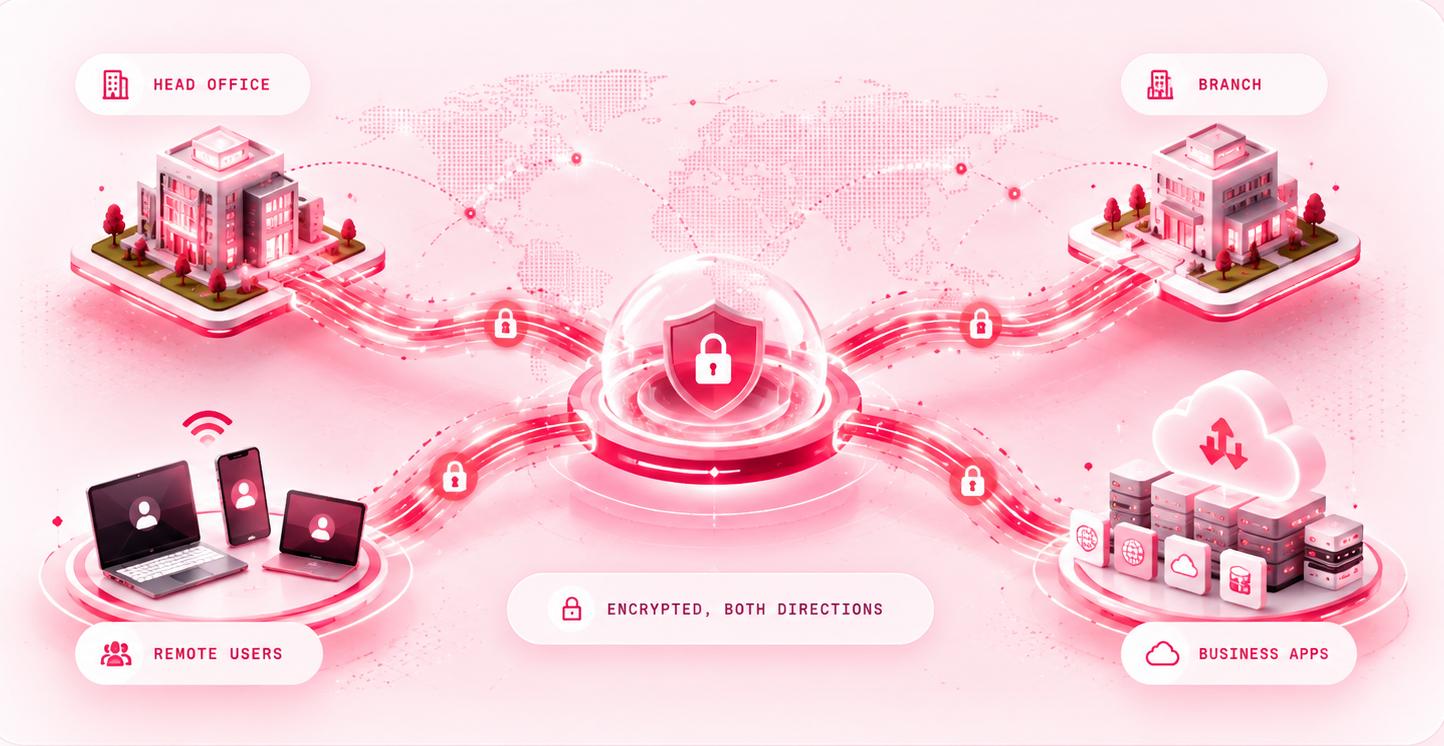
Without a VPN, every site and every remote worker is a separate network held together by exceptions. With one, there is a single network and a small number of controlled ways into it.
VPN
Connect locations and people securely.
SipLink VPN solutions securely connect business locations and authorised users across IP networks, using dedicated equipment and large-scale encryption to link fixed sites through secure firewall infrastructure.
The result is one network with controlled entry points, rather than several networks and a collection of exceptions.
Ideal for
- Multi-site businesses
- Remote and hybrid teams
- Branch and warehouse networks
- Regulated environments
Use cases
Four shapes of secure connection
Site-to-site VPN
Connect offices, branches, warehouses and other business locations as one network.
Remote access VPN
Let authorised employees reach business resources securely from wherever they are working.
Cloud connectivity
Connect business networks to supported cloud environments over a controlled path.
Secure application access
Provide controlled access to internal applications and resources, scoped per user.
Benefits
What it gives you
- Secure connectivity
- Centralised access policies
- Multi-location connectivity
- Remote workforce support
- Encrypted communication
- Controlled access to business resources
Between buildings, or between people and a building
Most businesses end up with both. They solve different problems and are worth deciding separately rather than as one purchase.
Site to site
Solves
Two or more offices that should behave as one network
- Always on, between fixed locations
- Configured once, on equipment at each end
- Staff notice nothing, the other office is simply reachable
- Usually configured against a fixed public address
Remote access
Solves
People who need the office network from somewhere else
- Per user, connected on demand
- Access scoped to what that person needs
- Removed when someone leaves, centrally
- Depends on the office address staying put
Three things a VPN will not do
A tunnel is a way in, not a security posture. These are the gaps people most often assume it closes.
It is not a firewall
A VPN decides who gets in. What they can reach once inside is a firewall and segmentation question, and it is the one more often left unanswered.
It does not create bandwidth
Traffic between sites still crosses the connections you have. If the link is the constraint, the tunnel over it will be too.
It is only as current as its access list
The value is in revoking access as reliably as granting it. That is a process, not a product, which is why it is worth managing rather than owning.
Site-to-site and remote access usually run together
Site-to-site and remote access read as a choice when they sit side by side. Most estates end up with both, doing different jobs, and with the limit that neither of them is a firewall.
What layers onto VPN
Connectivity is the first decision, not the last one. These are the services most often added on top of it.
Frequently Asked Questions
The questions we hear most before a business switches. Anything else, ask us and we will answer it.
Tell us where your offices are
We will check what is deliverable at each address, size the service against how you actually work, and quote the whole network, voice included, as one bill.
- Feasibility checked first
- You talk to an engineer
- Quoted per location
Availability, service levels and the exact scope of managed services are confirmed per location and set out in your agreement. All services are subject to technical feasibility at the time of order.